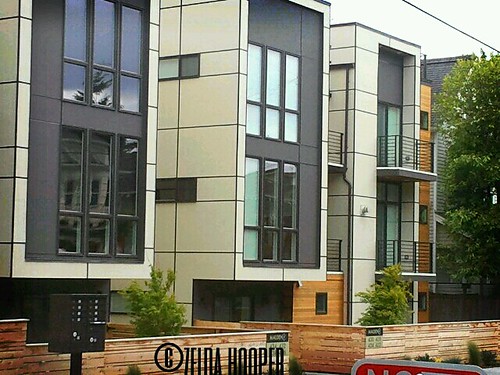
A housing cooperative is a legal entity - usually a corporation - that owns real estate; one or more residential buildings. Each shareholder in the legal entity is granted the right to occupy one housing unit, sometimes subject to an occupancy agreement, which is similar to a lease. The occupancy agreement specifies the co-op’s rules. Cooperative is also used to describe a non-share capital co-op model in which fee-paying members obtain the right to occupy a bedroom and share the communal resources of a house that is owned by a cooperative organization. Such is the case with student cooperatives in some college neighborhoods in the United States.
Legal status
As a legal entity, a co-op can contract with other companies or hire individuals to provide it with services, such as a maintenance contractor or a building manager. It can also hire employees, such as a manager or a caretaker, to deal with specific things that volunteers may prefer not to do or may not be good at doing, such as electrical maintenance. However, as many housing cooperatives strive to run self-sufficiently, as much work as possible is completed by its members.
A shareholder in a co-op does not own real estate, but a share of the legal entity that does own real estate. Co-operative ownership is quite distinct from condominiums where people “own” individual units and have little say in who moves into the other units. Because of this, most jurisdictions have developed separate legislation, similar to laws that regulate companies, to regulate how co-ops are operated and the rights and obligations of shareholders.
Ownership
Each resident or resident household has membership in the co-operative association. Members have occupancy rights to a specific suite within the housing co-operative as outlined in their “occupancy agreement”, or “proprietary lease” which is essentially a lease.
In some cases, the co-op follows Rochdale Principles where each shareholder has only one vote. Most cooperatives are incorporated as limited stock companies where the number of votes an owner has is tied to the number of shares owned by the person. Whichever form of voting is employed it is necessary to conduct an election among shareholders to determine who will represent them on the board of directors (if one exists), the governing body of the co-operative. The board of directors is generally responsible for the business decisions including the financial requirements and sustainability of the co-operative. Although politics vary from co-op to co-op and depend largely on the wishes of its members, it is a general rule that a majority vote of the board is necessary to make business decisions.
Management
In larger co-ops, members of a co-op typically elect a board of directors from amongst the shareholders at a general meeting, usually the annual general meeting. In smaller co-ops, all members sit on the board.
The board typically elects its own officers, such as a president, vice-president and so on. Usually, the directors are volunteers, or are paid an honorarium. The board may then establish standing committees from among the shareholders, who usually also volunteer their time, to either handle the business affairs of the co-op or make recommendations to the full board on such issues as its finance, membership and maintenance of its housing units.
Finance
A housing cooperative is normally de facto non-profit, since usually most of its income comes from the rents paid by its residents, who are invariably its members. There is no point in creating a deliberate surplus—except for operational requirements such as setting aside funds for replacement of assets—since that simply means that the rents paid by members are set higher than the expenses. (Note, however, that it’s quite possible for a housing co-op to own other revenue-generating assets, such as a subsidiary business which could produce surplus income to offset the cost of the housing, but in those cases the housing rents are usually reduced to compensate for the additional revenue.)
It is relatively difficult to start a housing co-op because if the idea is, for instance, to build a building or group of buildings to house the members, this usually takes a significant mortgage loan for which a financial institution will want assurances of responsibility. It may also take a year or more for the members to organize the design and construction, as well as time and foresight to establish even basic organizational policies. It is rare that these kinds of skills of organization are available in a random group of people who often have pressures on their existing housing. It may be somewhat easier to organize a group of closely related housing units. This opportunity may arise, for example, if an existing apartment building’s owner is thinking about selling it.
There are housing co-ops of the rich and famous: John Lennon, for instance, lived in a housing co-operative, and most apartments in New York City that are owned rather than rented are held through a co-operative rather than via a condominium arrangement.
There are two main types of housing co-operative financing methods, market rate and limited equity. With market rate, the share price is allowed to rise on the open market and shareholders may sell at whatever price the market will bear when they want to move out. In many ways market rate is thus similar financially to owning a condominium, with the difference being that often the co-op carries a mortgage, resulting in a much higher monthly fee paid to the co-op than would be so in a condominium. The purchase price of a comparable unit in the co-op is typically much lower, however.
With limited equity, the co-op has rules regarding pricing of shares when sold. The idea behind limited equity is to maintain affordable housing. A sub-set of the limited equity model is the no-equity model, which looks very much like renting, with a very low purchase price (comparable to a rental security deposit) and a monthly fee in lieu of rent. When selling, all that is re-couped is that very low purchase price.
Co-ops in Seattle
There are dozens of Co-op apartments in Seattle, mostly clustered in Capitol Hill and Queen Anne, with a handful in Greenlake and Ravenna. Because of the difficulty in financing, they are often priced about 10 to 20% lower in price than condominiums, but they offer an excellent and affordable way to jump into the housing market. Please contact Marlow Harris for a list of available Co-op apartments for sale at 206-329-3795. Thanks!